Challenges
1. Limited Accessibility and Maintenance Risk
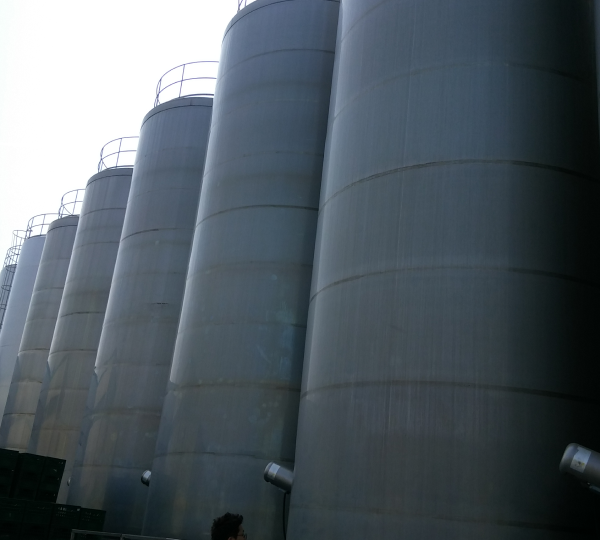
The outdoor silo tank was too tall to install and maintain a top-entry agitator safely.
Realistically, side-mounted installation was the only feasible option.
2. Leakage and Contamination Risk Under 150-Ton Pressure
Installing a side-mounted mechanical seal agitator at the lower part of the tank would expose the seal to extreme hydrostatic pressure from 20 meters of raw milk.
In the event of seal failure, there was a high risk of raw milk contamination and large-scale leakage
3. Insufficient Flow to Reach the 20-Meter Upper Layer
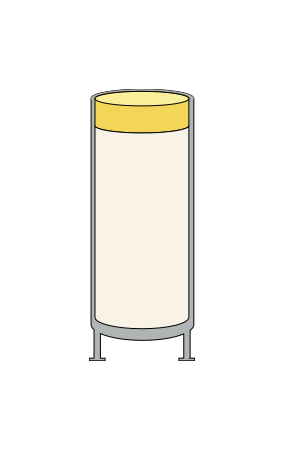
Conventional side-entry agitators mainly push fluid horizontally, making it difficult to mix the creaming layer formed at the top of the 20-meter tank.
SEDNA Solution
1. Leak-Free SHM Magnetic Mixer (Side-Mounted Magnetic Mixer)
SEDNA ENG applied the SHM side-mounted magnetic mixer, designed to withstand high hydrostatic pressure with no leakage risk.
Its seal-free isolation structure eliminates the risk of raw milk leakage caused by mechanical seal failure.
2. CFD-Driven Angle Optimization (Simulation-Verified Design)
Since full-scale testing with 150 tons of raw milk was nearly impossible, SEDNA ENG eliminated trial and error through CFD simulation.
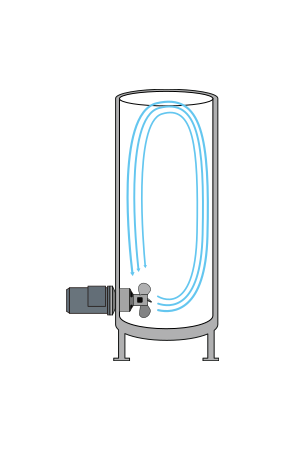
Based on simulation data, the mixer angle was precisely optimized to prove that flow generated at a height of 1.8 m could reach the top of the 20 m tank.
3. Dual Alternating System (24/7 Continuous Operation)
Two SHM mixers were installed per tank with an alternating operation logic.
By operating alternately, the system distributes motor load and maintains raw milk freshness continuously, 24 hours a day, 365 days a year.
PROBLEM
SOLUTION
- Results
01
Zero
Creaming
CFD-optimized vertical circulation prevented fat separation and creaming, even during long-term storage.
02
Risk-Free
Operation
Magnetic coupling technology eliminated leakage concerns under high hydrostatic pressure and enabled safe maintenance without working on the top of the outdoor tank.
03
Smart Engineering
Cost Saving
By identifying the optimal installation angle and position through simulation without full-scale trials, the project timeline and cost were significantly reduced.