Skip to content

Fluid Flow Improvement Project for a 10 kL Large-Scale Fermenter

Project Overview

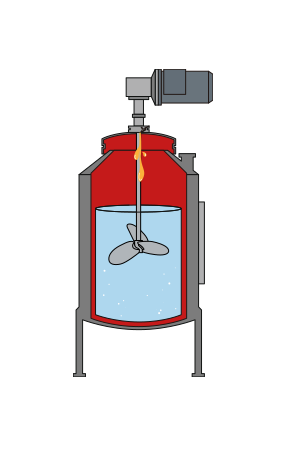
Global bio company A was operating a 10 kL pilot plant for the scale-up production of major amino acids, including tryptophan and lysine. However, due to the limitations of the single-shaft agitator, microorganisms did not grow uniformly, and localized stagnation occurred. To solve this issue, the air injection rate was increased, but the compressor capacity reached its limit. Company A requested SEDNA ENG to improve mixing efficiency and solve the problem without major equipment expansion.
Challenges

1. Limitations in Oxygen Transfer Efficiency and Equipment Load

During the rapid cell growth phase, dissolved oxygen shortage occurred repeatedly.To address this issue, excessive aeration was attempted, but the existing compressor capacity had already reached saturation, making it difficult to add a larger compressor.

2. Seal Wear and Contamination Risk(Existing Issues)

Due to the high-speed operation required in the fermentation process, concerns were continuously raised about foreign material contamination caused by wear of the mechanical seal in the existing top-entry agitator.

3. Instability in the Scale-Up Process

Unlike the pilot stage, the 10 kL large-scale tank experienced dead zones in fluid flow.As a result, amino acids accumulated at the bottom, reducing overall mixing uniformity.

SEDNA Solution

1. Down-Flow-Optimized Impeller Design

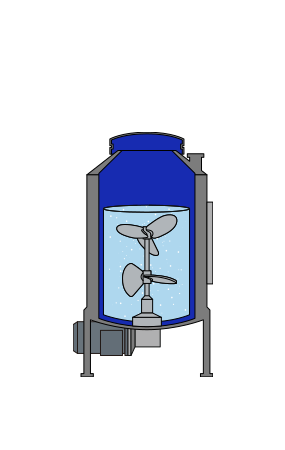
Through CFD simulation, SEDNA ENG applied a specialized impeller design that maximizes down-flow performance. This prevents air bubbles from rising directly to the liquid surface and creates strong circulation toward the bottom of the tank, significantly increasing gas hold-up time.

2. Seal-Free Isolation Structure

By applying magnetic coupling technology, SEDNA ENG achieved a clean process with no wear parts, even during high-speed operation. This fundamentally eliminates contamination risks caused by mechanical seal wear.

PROBLEM

SOLUTION

01

Improved Dissolved Oxygen (DO) Transfer Efficiency

By optimizing the impeller design, oxygen transfer efficiency was improved under the same aeration conditions, reducing compressor load.

02

Secured Compressor Capacity Margin

Additional margin was secured in the air injection capacity that had reached its limit, reducing CAPEX for large compressor expansion.

03

Improved Process Stability and Reproducibility

Stable DO control was achieved during the key growth phase of amino acid production, reducing batch-to-batch variation and improving productivity.

Get the Right Solution for Your ProcessExperience SEDNA ENG’s technical expertise and engineering partnership.