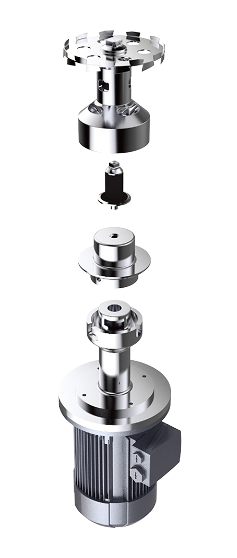
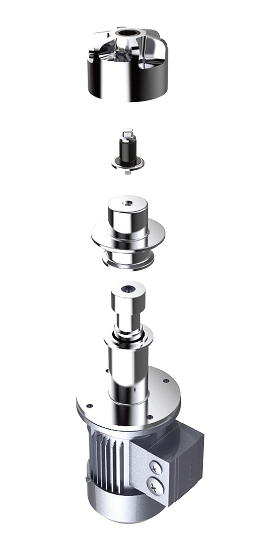
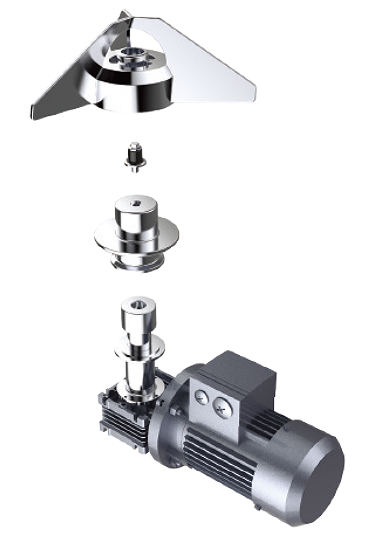
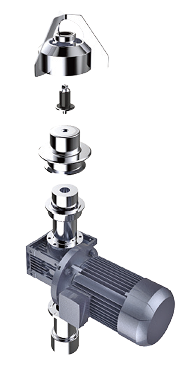
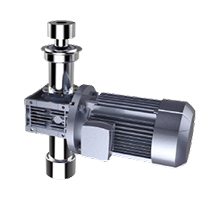
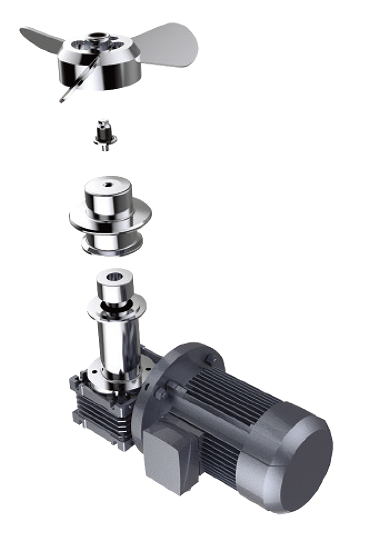
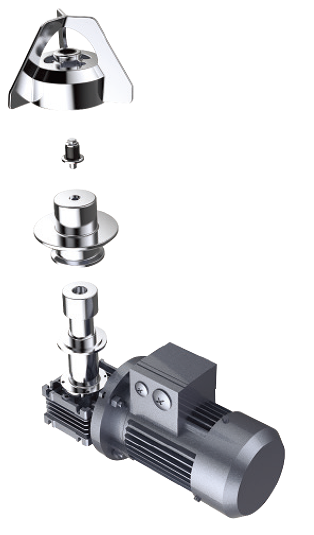
SRD

Model

Mixing volume Design RPM

SRD-60

50L(AC 1.5kw) 1500 RPM

SRD-100

150L(AC 2.2kw) 1500 RPM

SRD-150

700L(AC 4.0kw) 1500 RPM

SRD-200

1500L(AC 7.5kw) 1500 RPM

SRD-220

3000L(AC 11kw) 1500 RPM

Specification

SDP

Model

Mixing volume Design RPM

SDP-60

100L(AC 0.37kW) 1500 RPM

SDP-100

500L(AC 0.75kW) 1500 RPM

SDP-150

1000L(AC 2.2kW) 1500 RPM

SDP-200

2000L(AC 4.0kW) 1500 RPM

SDP-220

5000L(AC 7.5 kW) 1000 RPM

Specification

SDL

Model

Mixing volume Design RPM

SDL-100

300L(AC 0.25kW)~170 RPM

SDL-150

1000L(AC 0.37kW)~170 RPM

SDL-200

5000L(AC 0.75kW)~110 RPM

SDL-220

20000L(AC 1.5kW)~110 RPM

SDL-250

30000L(AC 1.5kW)~110 RPM

SDL-300

50000L(AC 2.2kW)~110 RPM

Specification

SDF

Model

Mixing volume Design RPM

SDF-60

50L (AC 0.25kW)~450 RPM

SDF-100

50L (AC 0.25kW)~450 RPM

SDF-150

700L (AC 0.75kW)~450 RPM

SDF-200

15000L (AC 1.5kW)~350 RPM

SDF-220

3000L (AC 2.2kW)~350 RPM

Specification

SDB

Model

Mixing volume Design RPM

SDB-60

20L(AC 0.25kW)~450 RPM

SDB-100

50L(AC 0.25kW)~450 RPM

SDB-150

150L(AC 0.37kW)~450 RPM

SDB-200

700L(AC 0.75kW)~450 RPM

SDB-220

1500L(AC 1.5kW)~350 RPM

SDB-250

3000L(AC 2.2kW)~350 RPM

SDB-300

7000L(AC 4.0kW)~350 RPM

Specification

SDM

Model

Mixing volume Design RPM

SDM-20

20L(AC 0.25kW)~450 RPM

SDM-60

50L(AC 0.25kW)~450 RPM

SDM-100

150L(AC 0.37kW)~450 RPM

SDM-150

700L(AC 0.75kW)~450 RPM

SDM-200

1500L(AC 1.5kW)~350 RPM

SDM-220

3000L(AC 2.2kW)~350 RPM

SDM-250

7000L(AC 4.0kW)~350 RPM

SDM-300

15000L(AC 5.5kW)~350 RPM

SDM-400

30000L(AC 7.5kW)~220 RPM

SDM-500

50000L(AC 11.0kW)~220 RPM

Specification

Extreme-Condition Mixing Solution for High-Temperature, Highly Corrosive, and Abrasive Lithium Extraction from Waste Batteries

Challenges

1. Leakage Hazard from Strongly Acidic Sulfuric Acid Vapor

If high-temperature sulfuric acid vapor leaked, it posed a serious threat not only to equipment corrosion but also to operator safety. Therefore, mechanical seals were fundamentally unsuitable, and complete containment technology was essential.

2. Corrosive Environment and Limitations of Stainless Steel

Even when a magnetic mixer made of standard SUS 316L was applied, it could not withstand the strongly acidic and high-temperature conditions for more than six months and had to be replaced due to corrosion. This caused significant production losses and maintenance costs.

3. Physical Abrasion Caused by Particles

Hard particles used to support lithium leaching, along with undissolved particles from ferrite, rotated at high speed and caused physical abrasion by wearing down the impeller and bearings. As a result, the service life of the agitator was drastically shortened.

SEDNA Solution

1. Hermetic Magnetic Coupling

SEDNA ENG applied a fully enclosed magnetic mixer driven by magnetic force, eliminating the risk of sulfuric acid vapor leakage. This resolved the most critical issue of operator safety.

2. Advanced Ceramic Coating Technology

To solve both chemical corrosion and physical abrasion, a special ceramic coating was applied to the impeller and all wetted surfaces. This provided outstanding corrosion resistance and surface hardness compared to standard stainless steel.

3. Extreme-Duty Material Application

For the most abrasion-prone bearing areas, high-hardness SiC silicon carbide bearings were applied instead of ceramic particles. This allowed stable long-term operation even in harsh acidic and abrasive environments where magnetic coupling isolation and bearing durability are critical.

PROBLEM

SOLUTION

01

200%+
Lifespan Extension

With ceramic coating and special bearing materials, the agitator service life was extended from 6 months to over 1 year, reducing maintenance costs and OPEX.

02

Zero Emission
& Safety

By completely preventing hazardous sulfuric acid vapor leakage, the system improved operator safety and enabled an environmentally compliant process.

03

Stable Lithium
Recovery

Stable mixing performance was maintained without shutdowns, even in harsh operating conditions, contributing to the target lithium recovery rate.

Bottom Sedimentation Prevention Solution to Maximize Filtration Efficiency in Wine Clarification

Challenges

1. Rapid Sedimentation of Filter Aids

Perlite and bentonite have a higher specific gravity than wine, causing them to settle at the bottom of the tank within a short time. Once settled, their adsorption surface area was reduced, making it difficult to achieve the expected filtration effect and resulting in lower wine quality.

2. Narrow and Tall Tank Geometry

For space efficiency, the filtration tank had a small diameter and a tall structure. This geometry required strong mixing power to lift the settled particles from the bottom and circulate them throughout the tank.

3. Difficulty in Top Installation and Maintenance

Installing an agitator with a long shaft at the top of the narrow tank would make maintenance and cleaning difficult and unsafe, requiring the tank cover to be opened or the shaft to be removed. Therefore, it was essential to keep the top space clear.

SEDNA Solution

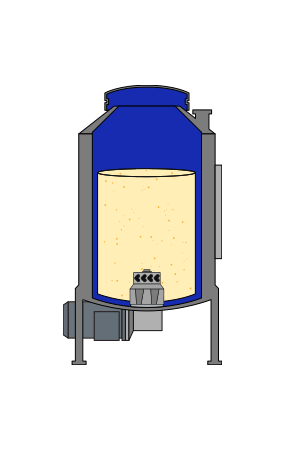
1. Bottom-Mounted SDM Magnetic Mixer

SEDNA ENG selected the bottom-mounted SDM magnetic mixer as the optimal solution to generate mixing force directly at the lowest part of the tank, where sedimentation occurs. This was the most effective position for re-suspending settled particles.

2. Powerful Upward Flow Generation

Considering the narrow and tall tank geometry, SEDNA ENG selected an impeller that generates strong upward flow. This continuously lifted perlite and bentonite from the tank bottom to the upper section, maintaining a uniform suspension.

3. Top Space Secured for Easy Maintenance

By moving the drive unit to the bottom of the tank, the complex top-mounted structure was eliminated. This allowed the tank cover to be opened freely, significantly improving the convenience and safety of maintenance and internal cleaning.

PROBLEM

SOLUTION

01

Maximized
Filtration Efficiency

Perlite and bentonite were evenly dispersed throughout the wine without settling, maximizing adsorption efficiency and enabling the production of clearer, higher-quality wine.

02

Effective Sediment
Re-suspension

Strong mixing force applied directly from the bottom completely re-suspended settled particles, even in a narrow and tall tank.

03

Improved Operational
Convenience

Securing open top space improved maintenance convenience for operators and reduced the risk of safety accidents.

Micro-Particle Homogenization and Seal Failure Solution for Premium Mayonnaise Production

Challenges

1. Viscosity-Induced Seal Failure

The mayonnaise process starts as a low-viscosity liquid, but as emulsification progresses, the viscosity rapidly increases to over 2,000 cP. This placed excessive load on the bottom mechanical seal, causing frequent seal failure and leakage.

2. Micro-Emulsification Requirement

To produce stable mayonnaise without phase separation, oil droplets must be broken down into very fine and uniform particles. The existing equipment could not achieve the required micrometer-level particle size distribution, resulting in quality deviation.

3. Contamination Risk Threatening Food Safety

When seal failure occurred, there was a risk of emulsified oil or wear particles entering the product. This posed a critical food safety issue.

SEDNA Solution

1. SSN High-Shear Magnetic Mixer

SEDNA ENG applied the SSN Series, a fully enclosed high-shear magnetic mixer with no mechanical seals. By using magnetic coupling technology, the root cause of seal failure was eliminated, enabling stable, leak-free operation even in high-viscosity emulsification processes.

2. Precision Rotor-Stator Technology

A powerful high shear force was generated through the combination of a precision-machined rotor and stator. By passing the fluid at high speed through the narrow gap, oil particles were uniformly reduced to the micrometer level.

3. Hygienic & Reliable Design

The seal-free structure fundamentally blocks contamination risks and ensures food safety. In addition, durable bearings and a powerful magnetic design provide reliable performance even during continuous high-load operation.

PROBLEM

SOLUTION

01

Perfect
Homogenization

Achieved the target micrometer-level uniform particle size, producing smooth, stable, high-quality mayonnaise without phase separation.

02

Zero Seal
Failure & Leakage

After applying magnetic technology, no seal failure or leakage occurred, reducing maintenance costs and improving equipment uptime.

03

Enhanced
Food Safety

By fundamentally blocking contamination pathways, the system created a safer and more hygienic production environment that meets HACCP standards.

High-Torque Mixing Solution for High-Viscosity Filler Production for Cartilage and Plastic Surgery Applications

Challenges

1. Instant High-Viscosity Change and Torque Load

Immediately after the cross-linker is added, the filler material rapidly changes from a liquid into a gel-like form within seconds. If the mixer cannot withstand the extreme viscosity resistance and torque load generated at this stage, serious issues such as mixing stoppage may occur.

2. Limitations of Conventional Turbulent Mixing

High-viscosity materials cannot be properly mixed with a conventional propeller, which may simply rotate without generating effective mixing. A special low-speed, high-torque blade was essential to move the entire material, including the material adhered to the tank wall.

3. Biocompatibility for Implantable Materials

As the product is directly injected into the human body, even the smallest impurities or extractables were not acceptable. All wetted parts had to meet USP Class VI medical-grade requirements.

SEDNA Solution

1. High-Torque SRFT Magnetic Mixer

SEDNA ENG selected the SRFT model, optimized for high-viscosity processes. Even during rapid viscosity changes, the mixer successfully delivered massive torque without magnetic decoupling.

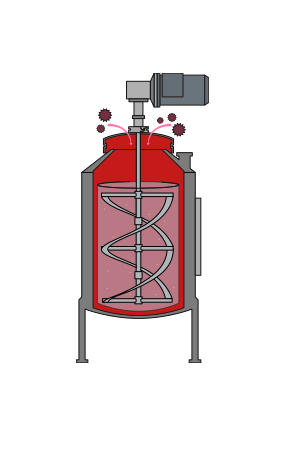
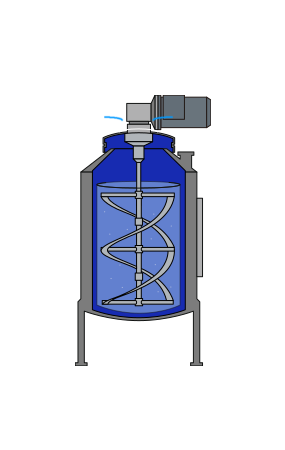
2. Helical Ribbon Blade (High-Viscosity Mixing Blade)

A large helical ribbon blade was applied to achieve effective laminar flow mixing, rather than turbulent mixing. Its spiral structure continuously moves material from the tank wall toward the center and lifts material from the bottom to the top, achieving complete mixing without dead zones.

3. USP Class VI Certified Materials

All wetted elastomers, including O-rings, were made only with USP Class VI certified materials. This ensures excellent biocompatibility by preventing harmful extractables, even under harsh process conditions.

PROBLEM

SOLUTION

01

Perfect Mixing
in High Viscosity

The helical ribbon blade and powerful torque maintained a uniform mixing state even when the material instantly transformed into a gel-like form, resulting in zero defects.

02

Biocompatible
& Safe

USP Class VI certified materials fundamentally blocked extractables and leachables risks, meeting the strictest medical device approval standards.

03

Stable
Operation

Stable operation was achieved without shutdowns, even under sudden load fluctuations, ensuring reliability in continuous production processes.