Extreme-Condition Mixing Solution for High-Temperature, Highly Corrosive, and Abrasive Lithium Extraction from Waste Batteries

Challenges

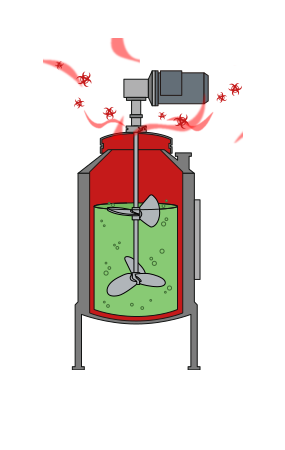
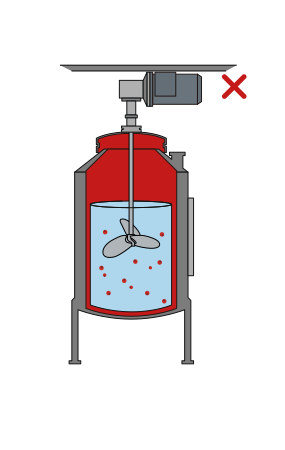
1. Leakage Hazard from Strongly Acidic Sulfuric Acid Vapor

If high-temperature sulfuric acid vapor leaked, it posed a serious threat not only to equipment corrosion but also to operator safety. Therefore, mechanical seals were fundamentally unsuitable, and complete containment technology was essential.

2. Corrosive Environment and Limitations of Stainless Steel

Even when a magnetic mixer made of standard SUS 316L was applied, it could not withstand the strongly acidic and high-temperature conditions for more than six months and had to be replaced due to corrosion. This caused significant production losses and maintenance costs.

3. Physical Abrasion Caused by Particles

Hard particles used to support lithium leaching, along with undissolved particles from ferrite, rotated at high speed and caused physical abrasion by wearing down the impeller and bearings. As a result, the service life of the agitator was drastically shortened.

SEDNA Solution

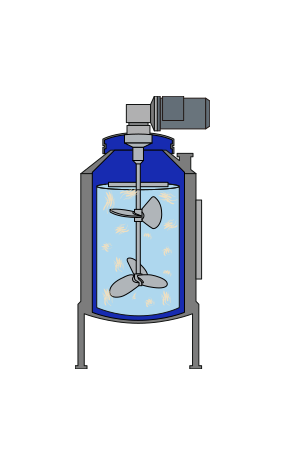
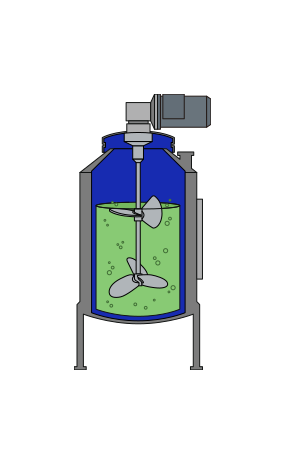
1. Hermetic Magnetic Coupling

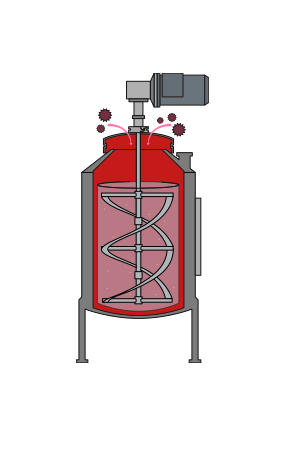
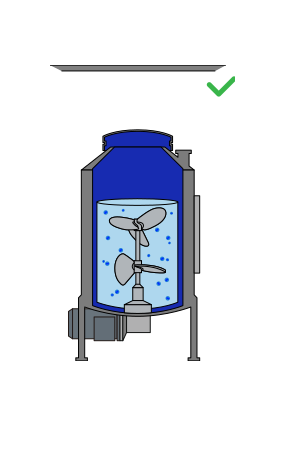
SEDNA ENG applied a fully enclosed magnetic mixer driven by magnetic force, eliminating the risk of sulfuric acid vapor leakage. This resolved the most critical issue of operator safety.

2. Advanced Ceramic Coating Technology

To solve both chemical corrosion and physical abrasion, a special ceramic coating was applied to the impeller and all wetted surfaces. This provided outstanding corrosion resistance and surface hardness compared to standard stainless steel.

3. Extreme-Duty Material Application

For the most abrasion-prone bearing areas, high-hardness SiC silicon carbide bearings were applied instead of ceramic particles. This allowed stable long-term operation even in harsh acidic and abrasive environments where magnetic coupling isolation and bearing durability are critical.

PROBLEM

SOLUTION

01

200%+
Lifespan Extension

With ceramic coating and special bearing materials, the agitator service life was extended from 6 months to over 1 year, reducing maintenance costs and OPEX.

02

Zero Emission
& Safety

By completely preventing hazardous sulfuric acid vapor leakage, the system improved operator safety and enabled an environmentally compliant process.

03

Stable Lithium
Recovery

Stable mixing performance was maintained without shutdowns, even in harsh operating conditions, contributing to the target lithium recovery rate.

Bottom Sedimentation Prevention Solution to Maximize Filtration Efficiency in Wine Clarification

Challenges

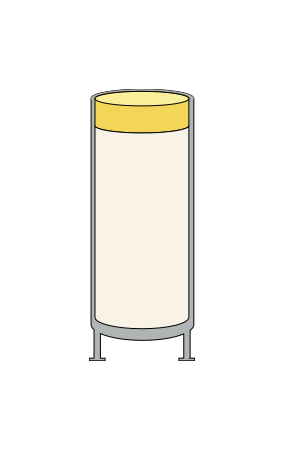
1. Rapid Sedimentation of Filter Aids

Perlite and bentonite have a higher specific gravity than wine, causing them to settle at the bottom of the tank within a short time. Once settled, their adsorption surface area was reduced, making it difficult to achieve the expected filtration effect and resulting in lower wine quality.

2. Narrow and Tall Tank Geometry

For space efficiency, the filtration tank had a small diameter and a tall structure. This geometry required strong mixing power to lift the settled particles from the bottom and circulate them throughout the tank.

3. Difficulty in Top Installation and Maintenance

Installing an agitator with a long shaft at the top of the narrow tank would make maintenance and cleaning difficult and unsafe, requiring the tank cover to be opened or the shaft to be removed. Therefore, it was essential to keep the top space clear.

SEDNA Solution

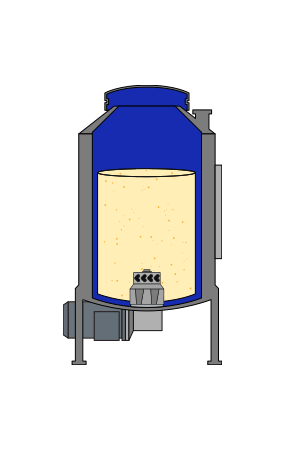
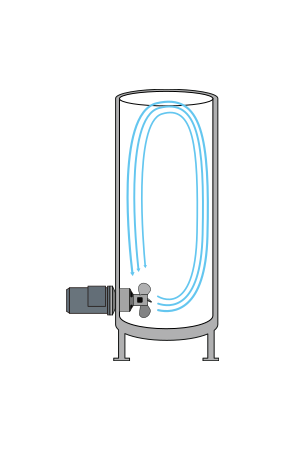
1. Bottom-Mounted SDM Magnetic Mixer

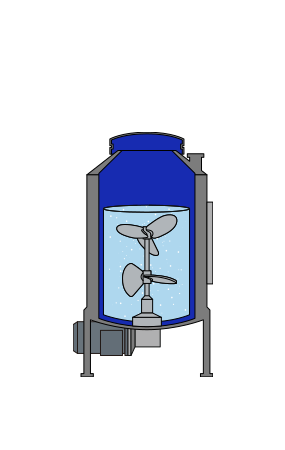
SEDNA ENG selected the bottom-mounted SDM magnetic mixer as the optimal solution to generate mixing force directly at the lowest part of the tank, where sedimentation occurs. This was the most effective position for re-suspending settled particles.

2. Powerful Upward Flow Generation

Considering the narrow and tall tank geometry, SEDNA ENG selected an impeller that generates strong upward flow. This continuously lifted perlite and bentonite from the tank bottom to the upper section, maintaining a uniform suspension.

3. Top Space Secured for Easy Maintenance

By moving the drive unit to the bottom of the tank, the complex top-mounted structure was eliminated. This allowed the tank cover to be opened freely, significantly improving the convenience and safety of maintenance and internal cleaning.

PROBLEM

SOLUTION

01

Maximized
Filtration Efficiency

Perlite and bentonite were evenly dispersed throughout the wine without settling, maximizing adsorption efficiency and enabling the production of clearer, higher-quality wine.

02

Effective Sediment
Re-suspension

Strong mixing force applied directly from the bottom completely re-suspended settled particles, even in a narrow and tall tank.

03

Improved Operational
Convenience

Securing open top space improved maintenance convenience for operators and reduced the risk of safety accidents.

Micro-Particle Homogenization and Seal Failure Solution for Premium Mayonnaise Production

Challenges

1. Viscosity-Induced Seal Failure

The mayonnaise process starts as a low-viscosity liquid, but as emulsification progresses, the viscosity rapidly increases to over 2,000 cP. This placed excessive load on the bottom mechanical seal, causing frequent seal failure and leakage.

2. Micro-Emulsification Requirement

To produce stable mayonnaise without phase separation, oil droplets must be broken down into very fine and uniform particles. The existing equipment could not achieve the required micrometer-level particle size distribution, resulting in quality deviation.

3. Contamination Risk Threatening Food Safety

When seal failure occurred, there was a risk of emulsified oil or wear particles entering the product. This posed a critical food safety issue.

SEDNA Solution

1. SSN High-Shear Magnetic Mixer

SEDNA ENG applied the SSN Series, a fully enclosed high-shear magnetic mixer with no mechanical seals. By using magnetic coupling technology, the root cause of seal failure was eliminated, enabling stable, leak-free operation even in high-viscosity emulsification processes.

2. Precision Rotor-Stator Technology

A powerful high shear force was generated through the combination of a precision-machined rotor and stator. By passing the fluid at high speed through the narrow gap, oil particles were uniformly reduced to the micrometer level.

3. Hygienic & Reliable Design

The seal-free structure fundamentally blocks contamination risks and ensures food safety. In addition, durable bearings and a powerful magnetic design provide reliable performance even during continuous high-load operation.

PROBLEM

SOLUTION

01

Perfect
Homogenization

Achieved the target micrometer-level uniform particle size, producing smooth, stable, high-quality mayonnaise without phase separation.

02

Zero Seal
Failure & Leakage

After applying magnetic technology, no seal failure or leakage occurred, reducing maintenance costs and improving equipment uptime.

03

Enhanced
Food Safety

By fundamentally blocking contamination pathways, the system created a safer and more hygienic production environment that meets HACCP standards.

High-Torque Mixing Solution for High-Viscosity Filler Production for Cartilage and Plastic Surgery Applications

Challenges

1. Instant High-Viscosity Change and Torque Load

Immediately after the cross-linker is added, the filler material rapidly changes from a liquid into a gel-like form within seconds. If the mixer cannot withstand the extreme viscosity resistance and torque load generated at this stage, serious issues such as mixing stoppage may occur.

2. Limitations of Conventional Turbulent Mixing

High-viscosity materials cannot be properly mixed with a conventional propeller, which may simply rotate without generating effective mixing. A special low-speed, high-torque blade was essential to move the entire material, including the material adhered to the tank wall.

3. Biocompatibility for Implantable Materials

As the product is directly injected into the human body, even the smallest impurities or extractables were not acceptable. All wetted parts had to meet USP Class VI medical-grade requirements.

SEDNA Solution

1. High-Torque SRFT Magnetic Mixer

SEDNA ENG selected the SRFT model, optimized for high-viscosity processes. Even during rapid viscosity changes, the mixer successfully delivered massive torque without magnetic decoupling.

2. Helical Ribbon Blade (High-Viscosity Mixing Blade)

A large helical ribbon blade was applied to achieve effective laminar flow mixing, rather than turbulent mixing. Its spiral structure continuously moves material from the tank wall toward the center and lifts material from the bottom to the top, achieving complete mixing without dead zones.

3. USP Class VI Certified Materials

All wetted elastomers, including O-rings, were made only with USP Class VI certified materials. This ensures excellent biocompatibility by preventing harmful extractables, even under harsh process conditions.

PROBLEM

SOLUTION

01

Perfect Mixing
in High Viscosity

The helical ribbon blade and powerful torque maintained a uniform mixing state even when the material instantly transformed into a gel-like form, resulting in zero defects.

02

Biocompatible
& Safe

USP Class VI certified materials fundamentally blocked extractables and leachables risks, meeting the strictest medical device approval standards.

03

Stable
Operation

Stable operation was achieved without shutdowns, even under sudden load fluctuations, ensuring reliability in continuous production processes.

Sedimentation Prevention and Quality Homogenization Project for a 400-Ton Edible Oil Tank

Challenges

1. Silicon Settling in a Large-Capacity Tank

Although silicon is essential for edible oil quality, it naturally settled at the bottom due to the massive 400-ton tank capacity and long storage time. This was not simply a mixing challenge, but a difficult task requiring the settled particles to be lifted and suspended.

2. Quality Deviation During Bottling

Since the tank outlet valve was located at the bottom, concentrated silicon was discharged in the early bottling stage, while later products contained oil with little or no silicon. This caused a critical quality issue that affected product taste and consistency.

3. Wide Tank Diameter and Dead Zones

Due to the extremely large tank diameter, conventional side-entry agitators could not effectively deliver flow to the center or opposite lower section of the tank. As a result, dead zones where sediment accumulated were inevitably formed.

SEDNA Solution

1. SHM with Extended Shaft (Extended Shaft Design)

Recognizing the lower specific gravity of silicon and edible oil, SEDNA ENG boldly extended the drive shaft of the SHM model to create more efficient fluid flow. This allowed the blade to be positioned deeper and closer to the center of the tank, enabling the vortex flow to reach the entire tank.

2. Zero-Deadzone Flow Dynamics

The extended blade generated a strong upward flow while sweeping along the tank bottom. This continuously lifted the settled silicon through re-suspension, completely eliminating dead zones at the bottom of the tank.

3. Smart Installation for Large Tanks

Considering the characteristics of the 400-ton tank, where top-mounted installation was difficult, SEDNA ENG applied a customized magnetic solution that maintained the side-mounted configuration while minimizing internal structural modifications.

PROBLEM

SOLUTION

01

Perfect Uniformity

Silicon concentration deviation across the entire 400-ton volume was brought within the required tolerance range, ensuring consistent quality regardless of the bottling stage.

02

Effective Sedimentation
Control

The extended shaft design solved the sedimentation issue and maintained a stable dispersion state, preventing silicon from settling even during long-term storage.

03

Optimized for
Mega-Scale

By accurately analyzing the specific gravity of edible oil and silicon, SEDNA ENG applied a customized long-shaft design to maximize the efficiency of large-scale equipment.

Side-Mounted Mixing Solution to Prevent Creaming in a 150-Ton Raw Milk Storage Tank

Challenges

1. Limited Accessibility and Maintenance Risk

The outdoor silo tank was too tall to install and maintain a top-entry agitator safely. Realistically, side-mounted installation was the only feasible option.

2. Leakage and Contamination Risk Under 150-Ton Pressure

Installing a side-mounted mechanical seal agitator at the lower part of the tank would expose the seal to extreme hydrostatic pressure from 20 meters of raw milk. In the event of seal failure, there was a high risk of raw milk contamination and large-scale leakage

3. Insufficient Flow to Reach the 20-Meter Upper Layer

Conventional side-entry agitators mainly push fluid horizontally, making it difficult to mix the creaming layer formed at the top of the 20-meter tank.

SEDNA Solution

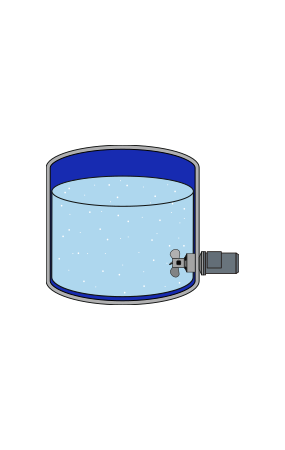
1. Leak-Free SHM Magnetic Mixer (Side-Mounted Magnetic Mixer)

SEDNA ENG applied the SHM side-mounted magnetic mixer, designed to withstand high hydrostatic pressure with no leakage risk. Its seal-free isolation structure eliminates the risk of raw milk leakage caused by mechanical seal failure.

2. CFD-Driven Angle Optimization (Simulation-Verified Design)

Since full-scale testing with 150 tons of raw milk was nearly impossible, SEDNA ENG eliminated trial and error through CFD simulation. Based on simulation data, the mixer angle was precisely optimized to prove that flow generated at a height of 1.8 m could reach the top of the 20 m tank.

3. Dual Alternating System (24/7 Continuous Operation)

Two SHM mixers were installed per tank with an alternating operation logic. By operating alternately, the system distributes motor load and maintains raw milk freshness continuously, 24 hours a day, 365 days a year.

PROBLEM

SOLUTION

01

Zero
Creaming

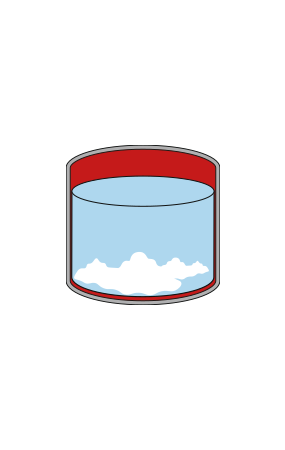
CFD-optimized vertical circulation prevented fat separation and creaming, even during long-term storage.

02

Risk-Free
Operation

Magnetic coupling technology eliminated leakage concerns under high hydrostatic pressure and enabled safe maintenance without working on the top of the outdoor tank.

03

Smart Engineering
Cost Saving

By identifying the optimal installation angle and position through simulation without full-scale trials, the project timeline and cost were significantly reduced.

특허받은 롤링 블레이드로 40일 장기 배양의 난제를해결한 산삼 배양근 프로젝트

Challenges

1. 40-Day Risk and Hermetic Containment

With a cultivation period of up to 40 days, even the slightest contamination during the process could result in the disposal of the entire 12-ton batch. Although this was a food process, it required pharmaceutical-level hermetic containment.

2. Surface Hardening and Growth Arrest

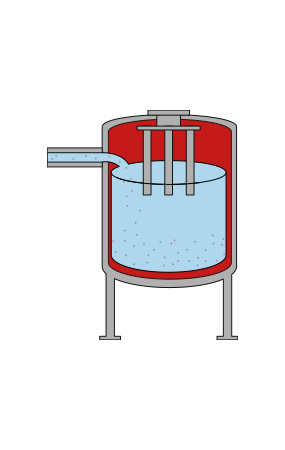
Cultured wild ginseng roots must remain submerged in liquid to grow properly. When exposed to air above the liquid surface, the roots harden, ginsenoside content decreases, and growth stops, creating a critical process issue.

3. Difficulty in Liquid Level Detection

As the cultured roots grew, they continuously absorbed the culture medium, causing the liquid level to change. Since the tank was densely filled with roots, conventional level sensors could not accurately detect the liquid level, making impeller position control difficult.

SEDNA Solution

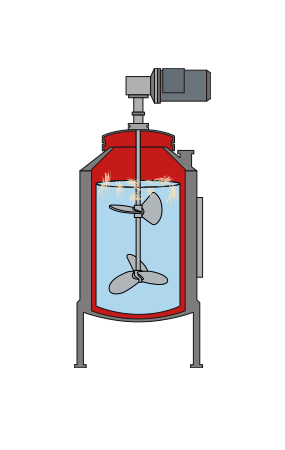
1. SRFT Top-Mounted Magnetic Mixer

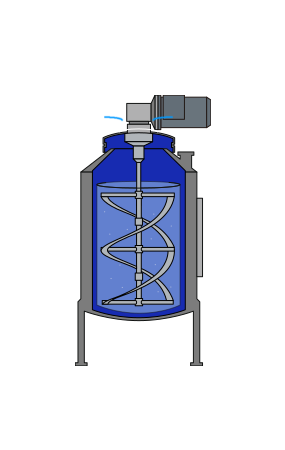
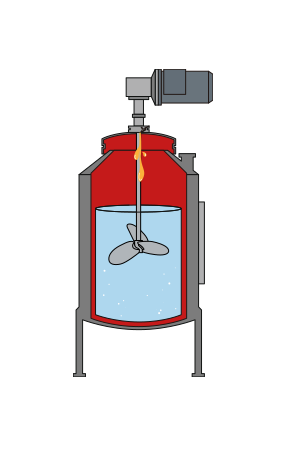
SEDNA ENG applied the SRFT top-mounted magnetic Agitator to eliminate contamination risks caused by seal wear. This enabled the process to maintain perfect aseptic conditions even during 40 days of continuous operation.

2. Patented Rolling Blade (Liquid-Level-Following Impeller)

To respond to liquid level changes without sensors, SEDNA ENG applied its patented Rolling Blade technology, using buoyancy and mechanical design. As the liquid level changes, the blade automatically rises and moves with the liquid surface, gently turning the cultured roots back into the medium for continuous wetting.

3. Optimized Oxygen Transfer

Through magnetic mixing, oxygen supplied from the bottom sparger is evenly dispersed throughout the culture medium. This allows the cultured roots to absorb sufficient oxygen, even in high-density cultivation conditions.

PROBLEM

SOLUTION

01

Reduced Surface Hardening

The Rolling Blade continuously wetted the cultured roots at the liquid surface, reducing surface hardening by over 50% and enabling the harvest of premium-quality cultured roots.

02

Auto-Leveling Performance

With a smart design that allows the impeller to follow the liquid level without complex sensor control, the system improved both process automation and operational convenience.

03

High-Purity Ginsenoside Production

By creating a stable cultivation environment, the process exceeded the target ginsenoside extraction yield and successfully completed the project.

Avian Influenza Vaccine Project Achieving Complete Sealing Without Process Modification

Challenges

1. Limits of Virus Containment and Sealing

Due to the nature of the process handling avian influenza virus, maintaining airtight containment to prevent external leakage was the top priority. However, the existing mechanical seal system had a risk of micro-leakage, requiring a more complete containment technology.

2. Maintaining Validation and Limited Top Space

To maintain the already validated process, a conventional bottom-mounted magnetic mixer requiring tank bottom modification could not be applied. A seal-free agitator was required while keeping the existing top-entry drive configuration.

3. Cleaning Difficulty of Sticky Egg Protein

Egg protein, the main raw material, has high viscosity and easily adheres to equipment surfaces. Therefore, even with a complex top-entry agitator structure, the system had to support complete CIP and SIP without dead zones.

SEDNA Solution

1. SRFT Series (Patented Top-Mounted Magnetic Mixer)

SEDNA ENG proposed the SRFT top-mounted magnetic mixer, patented in Korea, the U.S., and China. Although installed from the top of the tank, the SRFT uses magnetic coupling and an isolation barrier to completely separate the inside and outside of the tank without mechanical seals.

2. Seamless Retrofit (Fully Compatible with Existing Equipment)

The SRFT model is designed to fit a similar headspace as conventional mechanical seal agitators. This allowed Company C to replace only the agitator without modifying the tank or making major piping changes, while maintaining existing validation data and upgrading containment performance.

3. CIP/SIP Optimized Body Design

To address the customer’s cleaning concerns, the shaft and drive connection areas were specially designed to allow cleaning fluid to reach every internal surface. Actual CIP/SIP testing confirmed complete cleaning and sterilization with no protein residue.

PROBLEM

SOLUTION

01

Zero Leakage

By applying magnetic coupling technology, SEDNA ENG fundamentally blocked the risk of virus leakage and maximized process safety.

02

Validation Continuity

Through a 1:1 retrofit without tank modification, validation cost and time were significantly reduced.

03

Perfect Hygiene

Complete CIP/SIP performance with no residue was proven even in a challenging egg protein process, turning on-site concerns into confidence.

10-Ton Large-Scale Bioreactor Project for Cultured Meat Production in Europe

Challenges

1. Factory Ceiling Height Limitation

Although the tank capacity was as large as 10 tons, there was no available space to install a motor on the top due to the facility’s height limitations. A powerful drive system was required to control large-volume fluid while utilizing the lower space of the tank.

2. Shear Control for Tissue Formation

Cultured meat requires cells to aggregate and form tissue, making it extremely sensitive to shear stress. A large Ø1000 blade design was essential to uniformly mix heavy culture medium while operating at low RPM.

3. Hygienic Design to Prevent Cross-Contamination

As cultivated meat is classified as a food product, cross-contamination caused by residues can be critical. A drainable structure with no liquid pooling and complete protection against culture medium penetration into component gaps were required.

SEDNA Solution

1. Bottom-Mount & Custom Large Impeller

To overcome ceiling height limitations, SEDNA ENG applied a bottom-mounted magnetic mixer, placing the motor and gearbox at the bottom of the tank. A custom Ø1000 large impeller was also designed to generate sufficient fluid flow even at low RPM.

2. EHEDG-Grade Hygienic Design

To minimize shear stress and improve cleanability, the impeller blades and dish-shaped head were finished with super polishing for a smooth hygienic surface. Special elastomer sealing was also applied to prevent liquid ingress into internal components, ensuring hygienic performance in line with EHEDG guidelines.

3. Fully Drainable Zero-Pooling Structure

The lower part of the impeller was precisely machined to match the tank bottom geometry, creating a zero-pooling structure with no residual liquid after drainage

PROBLEM

SOLUTION

01

Fully Resolved Space Limitations

Successfully achieved 10-ton scale-up with a bottom-mounted drive system, without expanding the facility space.

02

Optimized Cell Viability and Tissue Formation

Created an optimal environment for cultured meat tissue formation through low-shear design and meticulous surface finishing.

03

Completed Global Logistics and Installation

Safely delivered and supported the installation of large-scale precision equipment manufactured in Korea, proving SEDNA ENG’s global project execution capability.

Fluid Flow Improvement Project for a 10 kL Large-Scale Fermenter

Challenges

1. Limitations in Oxygen Transfer Efficiency and Equipment Load

During the rapid cell growth phase, dissolved oxygen shortage occurred repeatedly.To address this issue, excessive aeration was attempted, but the existing compressor capacity had already reached saturation, making it difficult to add a larger compressor.

2. Seal Wear and Contamination Risk(Existing Issues)

Due to the high-speed operation required in the fermentation process, concerns were continuously raised about foreign material contamination caused by wear of the mechanical seal in the existing top-entry agitator.

3. Instability in the Scale-Up Process

Unlike the pilot stage, the 10 kL large-scale tank experienced dead zones in fluid flow.As a result, amino acids accumulated at the bottom, reducing overall mixing uniformity.

SEDNA Solution

1. Down-Flow-Optimized Impeller Design

Through CFD simulation, SEDNA ENG applied a specialized impeller design that maximizes down-flow performance. This prevents air bubbles from rising directly to the liquid surface and creates strong circulation toward the bottom of the tank, significantly increasing gas hold-up time.

2. Seal-Free Isolation Structure

By applying magnetic coupling technology, SEDNA ENG achieved a clean process with no wear parts, even during high-speed operation. This fundamentally eliminates contamination risks caused by mechanical seal wear.

PROBLEM

SOLUTION

01

Improved Dissolved Oxygen (DO) Transfer Efficiency

By optimizing the impeller design, oxygen transfer efficiency was improved under the same aeration conditions, reducing compressor load.

02

Secured Compressor Capacity Margin

Additional margin was secured in the air injection capacity that had reached its limit, reducing CAPEX for large compressor expansion.

03

Improved Process Stability and Reproducibility

Stable DO control was achieved during the key growth phase of amino acid production, reducing batch-to-batch variation and improving productivity.